
Social media can help children communicate, learn and find communities. But it can also spread content that presents hatred, discrimination or violence as acceptable, heroic or inevitable. When exposure to such content begins early and happens frequently, it may gradually start to seem like an ordinary part of the online environment—and of life beyond it.
Children do not form their attitudes towards violence through the internet alone. Protective factors develop through secure relationships with adults, a sense of belonging, critical-thinking skills, and trust that rules apply to everyone. An environment in which violations of human dignity, humiliation and hate speech are presented as normal in politics and public debate—and in which impunity seems commonplace—can make it harder to reject such behaviour. Uncertainty about the future, social isolation and the absence of trusted adults can further increase some children’s vulnerability.
Radicalisation is not a sudden event and cannot be identified by a single sign.
Online radicalisation towards violence is a complex process in which people, through their online interactions and exposure to different types of online content, begin to see violence as a legitimate way of resolving social and political conflicts. Some people who experience violent radicalisation online may later commit terrorist acts.
In broad terms, it can be understood as a process in which a person gradually adopts views that justify, encourage or incite violence against people or groups. Not every extreme, provocative or unpopular opinion is unlawful—freedom of expression in a democratic society includes the possibility of debate and disagreement. Risk arises when content dehumanises people, incites hatred or violence, glorifies perpetrators of violence, or directs users towards extremist communities.
What this may look like online
Content does not always appear as a direct call to violence. It may come in the form of memes, videos, music, “jokes”, conspiracy claims, groups in messaging apps, or profiles that portray certain people as “enemies”.
Take notice if a child repeatedly encounters or shares posts that:
- portray people or groups as less than human, dangerous, or “responsible” for all social problems;
- justify attacks, terrorist acts or violence as “defence”, “revenge” or “heroism”;
- encourage hatred or violence because of ethnicity, religion, nationality, sex, sexual orientation, disability or another protected characteristic;
- promise belonging, “secret knowledge” or status in return for loyalty to a group;
- call for vigilante action and for “justice” to be delivered against people who supposedly do not deserve to live because of something they are alleged to have done;
- move conversations to closed chats, anonymous channels or platforms where pressure is applied to keep secrets.
These signs do not, on their own, prove radicalisation. They are a reason to take an interest, start a conversation and, if necessary, seek support. The child may be exploring a topic, may have come across such content by chance, or may be seeking a reaction from adults.
How to start a conversation
Begin with curiosity rather than interrogation: “What do you like about this profile or video?”, “How do you understand this message?”, “How do you think the person it is aimed at would feel?” The goal is not to win an argument, but to preserve trust in the relationship and help the child learn to recognise manipulative messages.
It can be helpful to check together who created the post, what sources it uses, whether the image or video has been taken out of context, and how the platform recommends similar content. Algorithmic systems and recommendation mechanisms are among the factors that should be considered when assessing systemic risks on the largest platforms.
Do not repost, comment approvingly on, or distribute content that glorifies or incites violence—even if the intention is to “show how dangerous it is”. If there is a specific risk to someone’s safety, seek immediate help from the relevant authorities by calling 112.
What parents can do
Use the platform’s reporting tools and keep the necessary information—for example, a link to the profile or post and a screenshot—without sharing the harmful content itself. If there is a threat, incitement to imminent violence or information about a planned crime, do not rely solely on reporting the content to the platform.
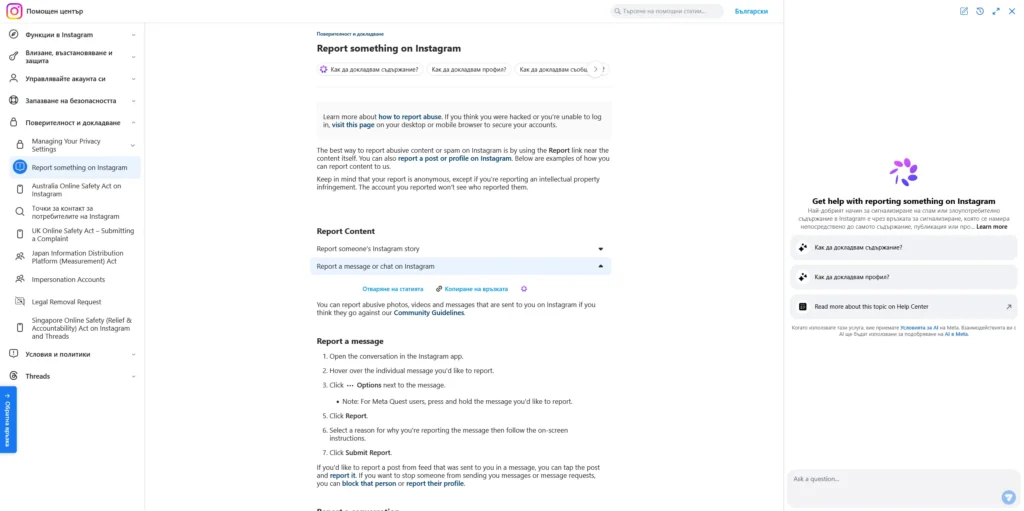
Screenshot of an Instagram help page on reporting content and profiles. In addition to checking the types of content prohibited by the platform’s Terms of Use—and the ways to report posts and profiles—users can use the chatbot to ask questions about a specific situation and reach the most appropriate solution more quickly.
Support the child in learning to recognise emotional pressure, false dilemmas such as “you are either with us or against us”, dehumanising language and unverified claims. It is especially important that the child knows they can turn to a parent, teacher, school psychologist or another trusted adult without being punished for having seen disturbing content.
What obligations do platforms have?
All providers of intermediary services covered by the Digital Services Act (DSA) have certain obligations depending on the type of service they provide. However, the specific framework for assessing and mitigating systemic risks under Articles 34 and 35 of the DSA applies to very large online platforms and very large online search engines—not to every such website, app or service.
These largest services must properly identify, analyse and assess the systemic risks arising from the way they are designed and operate, including their algorithmic systems, as well as from the way they are used. They must put in place reasonable, proportionate and effective measures tailored to the identified risks and their impact on fundamental rights, including freedom of expression.
The second annual report of the European Board for Digital Services and the European Commission, issued under Article 35(2) of the DSA, identifies illegal content, content from terrorist and violent groups, illegal hate speech and incitement to hate crimes, as well as risks to public security and the protection of minors, as prominent and recurring systemic risks.
EU legal framework
Illegal hate speech is not simply “offensive” content. Whether a particular post is unlawful depends on applicable EU law and national criminal law. Therefore, not every disturbing, discriminatory or extreme piece of content is necessarily subject to removal as illegal.
In January 2025, the revised Code of Conduct on Countering Illegal Hate Speech Online was incorporated into the DSA framework as a code of conduct under Article 45. Its purpose is to help prevent and counter the spread of illegal hate speech online, as defined by EU and Member State law.
Separately, Regulation (EU) 2021/784 on addressing the dissemination of terrorist content online provides that, where a competent national authority issues a removal order, a hosting service provider must remove or disable access to terrorist content as soon as possible and no later than one hour after receiving the order.
See also:
- Have We Become Used to Hate Speech? What Young People Do Not Know About Online Aggression
- Second report of the European Board for Digital Services and the European Commission on systemic risks related to very large online platforms and search engines under the Digital Services Act
- European Report Calls for Stronger Platform Accountability for Children’s Online Safety
- EU Council Calls for Urgent Measures Against Online Violence Against Girls and Support for Trusted Flaggers
- Guide to Critical Thinking, Tolerance and Preventing Radicalisation Among Teenagers