
At the moment, the symbols of an anti-human ideology and a protocol for harassment are receiving widespread media coverage. We risk a wave of copycat behavior.
People will continue to talk about what happened on Youth Hill in Plovdiv – who is to blame, which institutions failed to act in time, and where the radicalization of the children involved in the murder came from. Analysis is important, and these questions must be answered.
But at SafeNet.bg, we believe that, in the interest of children and society as a whole, we must urgently turn our attention to the next important question: “How can we prevent this from happening again? What can we do today, right away? What protective mechanisms should we build around young people from this point forward?”.
We express our position simply and unequivocally because we believe that protecting children from dangerous behavior is more important than choosing our words carefully.
What Should We Do Today, Right Away?
Let’s prevent the risk of copycat behavior. This means:
- To stop quoting and publicizing the methodologies of neo-fascists in interviews – this amounts to broadcasting on national television a practical “рецепта” for luring people into traps and taking the law into one’s own hands through humiliation.
- Stop publicly disclosing information about all the children and adults involved in this tragedy – their place of residence, family status, and school.
- Stop showing hand gestures with a bent thumb made by interviewees, media figures, commentators, authors, and members of the public.
- Each of us must overcome the emotional impact of the tragedy and stop spreading violent content by sharing it.
- Each of us can use the features available on social media platforms to report violent content – whether that means reporting a post, reporting a profile, or helping a child set up their social media profiles so they don’t see certain content.
Right now, the symbols of an anti-human ideology and a protocol for harassment are receiving widespread media coverage. We must put an end to “riding the wave of algorithms” because of this current topic. Presenting more and more details about what happened on Youth Hill in Plovdiv and constantly repeating them only risks turning a great tragedy into a spectacle, leading to secondary victimization and copycat behavior.
What Should We Do Moving Forward?
Let’s put an end to the normalization of violence and start fostering an attitude of zero tolerance – not just in words, but in practice – by putting three protective mechanisms in place around children. These are: the family, education, and public attitudes, which the media shape to a large extent.
The conversation begins with the first and closest circle – the family
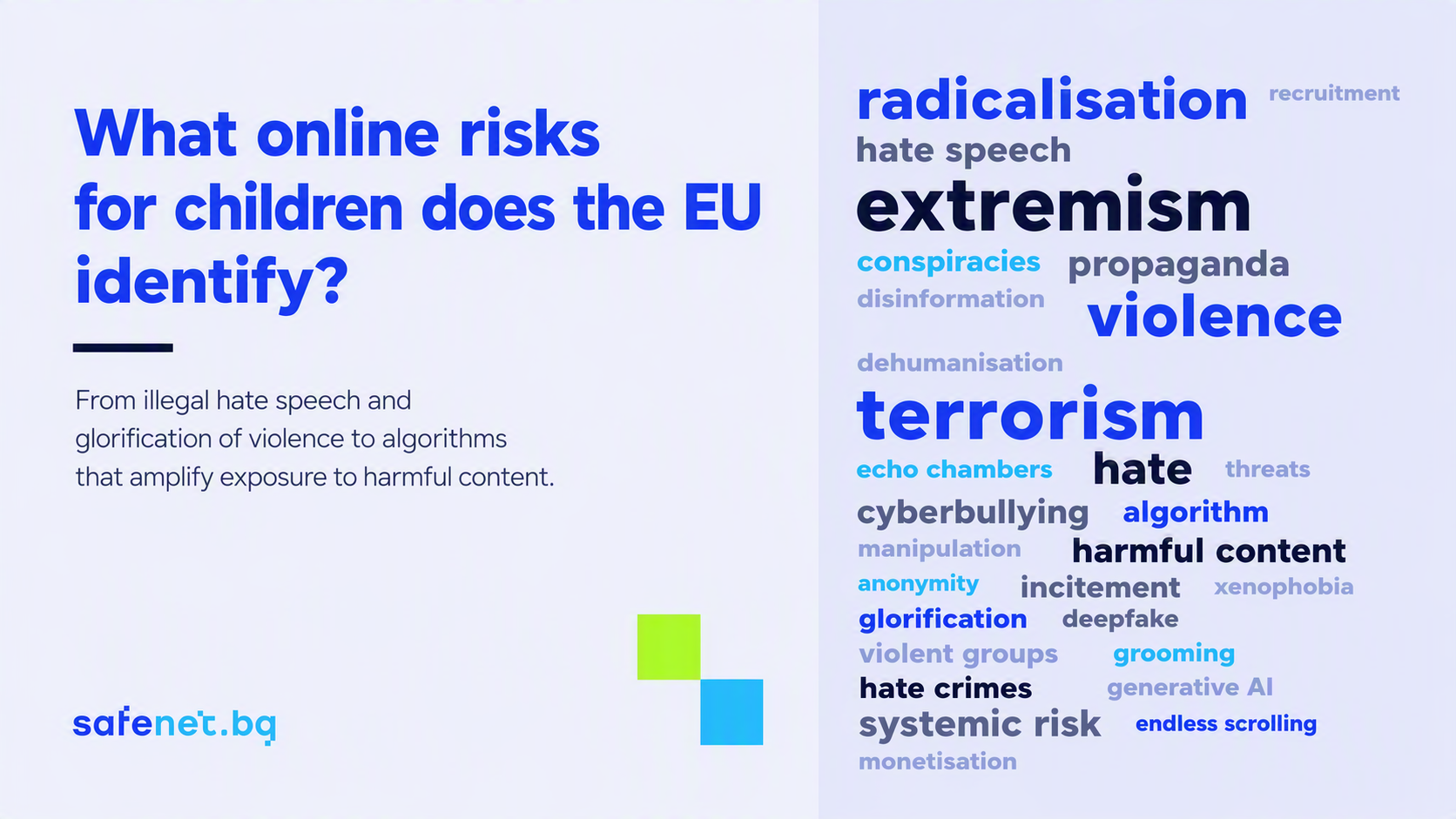
Children are finding it increasingly difficult to recognize hate speech as a problem and images and videos of violence as something wrong. All of this has become part of the backdrop of their daily digital lives, rather than a cause for concern. According to data from the Center for the Study of Democracy As of 2019, 52% of Bulgarian youth aged 14 to 19 have been exposed to radical online content that incites aggression and hatred. Nearly 15% approve of content that promotes discrimination, hatred, or aggression.
Children also witness impunity, dysfunctional institutions, and rude behavior among adults – from what they see on the street to politicians on the screen. No matter how “нахакан” a teenager may seem in their behavior and words, behind that facade lies a sense of vulnerability.
This is how children come to view violence and “лова на врагове” as an acceptable way to feel safe and to mete out their own brand of justice.
A child’s resilience against messages that incite aggression and violence is not built through supervision, but through relationships – a secure bond with an adult, a sense of belonging, critical thinking, and the confidence that rules apply to everyone.
Talk to your child at home.
Start the conversation with curiosity, not with a series of questions. Instead of asking, “Защо гледаш това?”, ask your child: “Какво ти харесва в този профил или клип?”, “Как разбираш това послание?”, “Как мислиш, че би се почувствал човекът, към когото е насочено?” – questions that open up a dialogue rather than shut it down.
Do not share harmful content, even with good intentions. Do not share posts that glorify violence “за да покажете колко е опасно” – this only increases their reach.
Help your child recognize manipulation. Discuss the skills needed to recognize emotional pressure, false dilemmas such as “или си с нас, или си враг”, dehumanizing language directed at certain groups of people, and unverified claims.
Reassure your child that they can come to you without fear of punishment. Reassure your child that they can come to you without fear of punishment.
Review the content together with your child. Work together to figure out who is behind a post, examine the actual sources, determine whether the images have been taken out of context, and understand why the platform is recommending that particular content – this way, your child will learn to do this kind of fact-checking on their own.
Know how and where to report it. Right now, violent content is spreading like wildfire. Use the built-in buttons to report a post, report a profile or user, and remove content you don’t want to see: “Not interested,” “Hide,” “Show less,” and “Manage topics” in Settings, which allows you to directly disable certain topics (e.g., violence). Teach your child how to do this as well.
If you need help setting up a child’s profile based on their age, please contact one of our specialists at 124 123 for specific instructions.
More articles that will help you if you’re a parent:
When Online Content Normalizes Violence: How to Talk to Our Children
Have We Become Desensitized to Hate Speech? What Young People Don’t Know About Online Aggression
On the International Day Against Hate Speech: What It Is, What Causes It, and What We Can Do
Parents Association – The Visible Children: SOS for Challenging Behavior
“Steps Together Against Bullying in School” Program
School – the bigger home where children learn about citizenship, a sense of belonging, and values
While the family lays the foundation, school is the place where a child learns what it means to be part of a larger community with rules that apply to everyone – rather than a group that decides for itself who the “враг” is and how to punish them.
Media literacy, critical thinking, and social-emotional learning are central to a child’s ability to evaluate information and its sources and to recognize a manipulative “рецепта” for violence, rather than uncritically accepting it as a role model.
In 2025, Bulgaria ranked second-to-last in the EU in terms of the percentage of young people (ages 16 to 24) who possess at least basic digital skills – only 53% of young people in Bulgaria meet this criterion, compared to an EU average of 75%. The lack of sufficient digital literacy and social skills is one of the reasons why children are unable to surf the internet safely on their own, and many children circumvent the age restrictions on social media by registering with a false age (often over 18), which leaves them unprotected against inappropriate content.
Lower levels of digital and media literacy carry the risk of a reduced ability to recognize manipulative or extremist content, disinformation, and algorithmic “тласкане” toward increasingly extreme content. This is what led to the events in Plovdiv. And not only there.
A recent sCOOL Media article titled “От тиха омраза до насилие” examined the hidden radicalization of young people in Bulgaria through the infiltration of “инцел” culture and the so-called “маносфера” into the Bulgarian online space, and how society often underestimates the phenomenon, parents, and institutions as “интернет хумор,” when in fact it conceals an ideology built on misogyny, social isolation, and the risk of escalating into real-world violence.
To prevent future incidents of radicalization and violence in society, the Bulgarian education system needs a national program for social and emotional learning focused on conflict resolution, nonviolent communication, digital literacy, and the prevention of radicalization.
SafeNet.bg offers a ready-to-use, classroom-ready tool designed specifically for this purpose – with lesson plans and ten modules that address precisely the missing links: rights and rules, recognizing emotions, principles of nonviolent communication, assertive behavior, anger management, online bullying, critical thinking and fake news, tolerance, and conflict resolution
See also:
A Guide to Critical Thinking, Tolerance, and the Prevention of Radicalization Among Teenagers
The Social Environment – The Role of the Media
The third line of defense for children is society as a whole, and in times like these, the media serves as its mirror. The way we report on such cases does more than simply inform – it sets an example for other young people who are watching.
The National Center for a Safer Internet supports the position of the Association of European Journalists in Bulgaria – the media should not portray vigilantism and other illegal practices as an acceptable or commendable model of behavior. Cases involving violence should be covered critically, with a clear explanation of all the contradictions and risks involved – not as a cause, but as a problem that must be understood and prevented.
In the coverage of the case in Plovdiv, several specific violations of ethical standards stand out.
Publications that list the specific schools attended by the accused children, along with their age, grade, and place of residence, make the children identifiable within the local community, even though they are not formally named. This approach also leads to additional trauma for a much wider circle of children and adults beyond those directly involved.
We have witnessed experts on national television who, in an attempt to explain radicalization, recount neo-fascist ideology step by step – which is, in effect, sharing a “рецепта за насилие” with a mass audience.
Publicly recounting every sadistic detail of the victim’s torture – beyond what is necessary to inform the public and meet the needs of the investigation – is a line that marks the beginning of a desire for sensationalism.
We also observed that a platform was provided to individuals organizing “лов” for the purpose of vigilante justice, involving minors, including the promotion of publications described as “наръчник” for such actions. It is precisely this kind of legitimization that brings the media close to the legally prohibited preaching of anti-democratic ideology.
Safenet.bg calls on the Council for Electronic Media to monitor and evaluate the coverage of the incident in Plovdiv for violations of the Radio and Television Act. We urge the media to follow the recommendations set forth in the AEJ’s position statement, as well as to adhere to the Code of Ethics for Bulgarian Media and the Guide to Ethical Reporting on Children, developed by the AEJ and UNICEF.
More resources:
The Position of AEJ-Bulgaria: The media should not glorify vigilantism and other illegal practices
A Guide to Ethical Reporting on Children by AEJ-Bulgaria and UNICEF
Code of Ethics for the Bulgarian Media
The question is no longer just what happened. The question is what kind of society we are creating before our children’s eyes, and what each of us will do from now on to stop the normalization of violence.